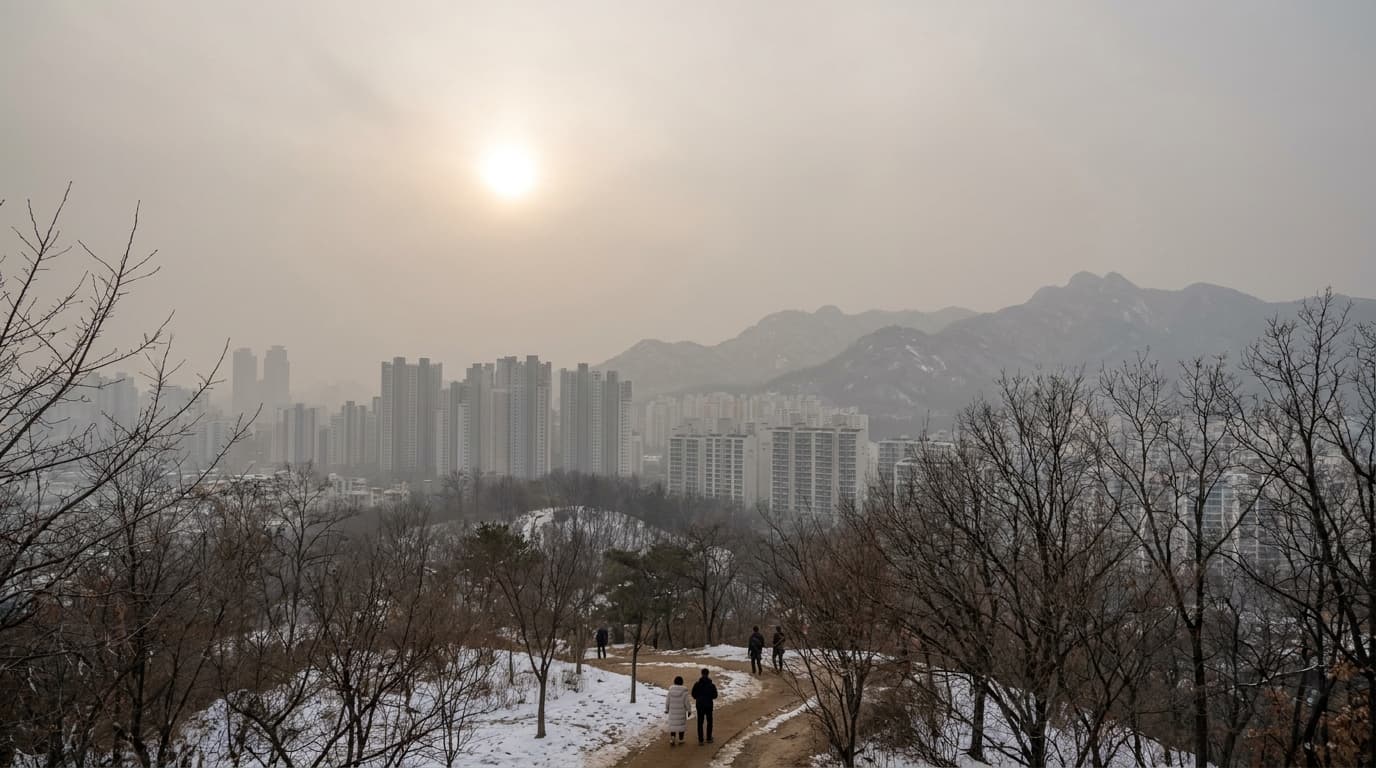
Some mornings in Seoul you can't see the mountains, the sky has gone beige, and your phone says 나쁨 (bad). That is fine dust (misemeonji, 미세먼지), and between December and March it decides whether you open your windows, wear a mask on the way to class or skip the run along the Han River.
Last updated: October 26, 2026 (KST)
Here is the bottom line. Check the PM2.5 number, not the sky: under 35 µg/m³ is fine for normal life, 36 to 75 is "bad" and over 75 is "very bad". A KF80 mask is enough for most people on bad days; KF94 is for sensitive groups and the worst days. Keep ventilating even on bad days, three times a day for about 10 minutes, then run an air purifier if you have one. Rentals start around 19,000 to 25,000 KRW a month. The government's winter dust measures usually start on December 1, and the 2026 to 2027 plan is expected in late November.
What the Numbers Mean
Korea's forecasts use four grades, based on the daily average in micrograms per cubic metre. When the PM10 and PM2.5 grades differ, the worse one is shown.
| Grade | PM2.5 (fine) | PM10 (coarse) | What to do |
|---|---|---|---|
| 좋음 Good | 0 to 15 | 0 to 30 | Nothing |
| 보통 Moderate | 16 to 35 | 31 to 80 | Normal life; sensitive groups take care |
| 나쁨 Bad | 36 to 75 | 81 to 150 | Mask outdoors, shorter ventilation, less outdoor exercise |
| 매우나쁨 Very bad | 76 and up | 151 and up | Mask, stay indoors where you can |
PM2.5 is the one that matters most, because the particles are small enough to reach deep into your lungs. For comparison, the WHO's 2021 guideline for a 24-hour average is 15, the top of Korea's "good" band. An advisory (주의보) is issued when PM2.5 stays at 75 or more for two hours, and a warning (경보) at 150 or more.
Where to check: AirKorea, the national network, has an English website at airkorea.or.kr/eng with hourly readings. Its app is Korean only. Many foreigners use IQAir in English, but it shows the US AQI scale, so its numbers will not match Korean grades. The Korean app Misemise (미세미세) uses face icons and is easy to read without Korean. The Emergency Ready (안전디딤돌) app sends English alerts when an advisory goes out.
When It Is Worst, and Why
The Korea Disease Control and Prevention Agency treats December to March as high-dust season. From 2015 to 2022, the average PM2.5 was 24 in December, 27 in January and February, and 28 in March, and March had the most "bad" days. Spring adds yellow dust (hwangsa, 황사) from the deserts of China and Mongolia, mostly from March to May with a peak in April.
Seoul's air has improved a lot. The annual PM2.5 average was 18 in 2025, down 40 percent from 30 in 2006, with 182 good days and 32 bad days. Winter is still the problem: Seoul averaged 24.3 from December 2024 to March 2025, the highest of Korea's 17 provinces and major cities.
As for where it comes from, estimates vary by year and method. A joint study by Korea's environmental research institute and NASA put China's share at about 55 percent in February and March 2024, while a 2019 Korea, China and Japan report estimated about 32 percent over the year. A fair summary is roughly a third on an annual average, rising to more than half during winter episodes. Cold, still air traps local pollution too, which is why calm, grey days are the worst.
💡 TIP: Korean winters tend to swing between cold, clear days and milder, dusty ones. When the forecast turns orange, do your laundry run and grocery shop before it starts.
Which Mask to Buy
Korean dust masks are graded KF (Korea Filter) by the Ministry of Food and Drug Safety.
- KF80: blocks at least 80 percent of particles around 0.6 µm. Approved for fine dust and yellow dust.
- KF94: blocks at least 94 percent of particles around 0.4 µm, with less leakage at the edges. Also approved for infection protection.
- KF99: blocks at least 99 percent. Hard to breathe through for long.
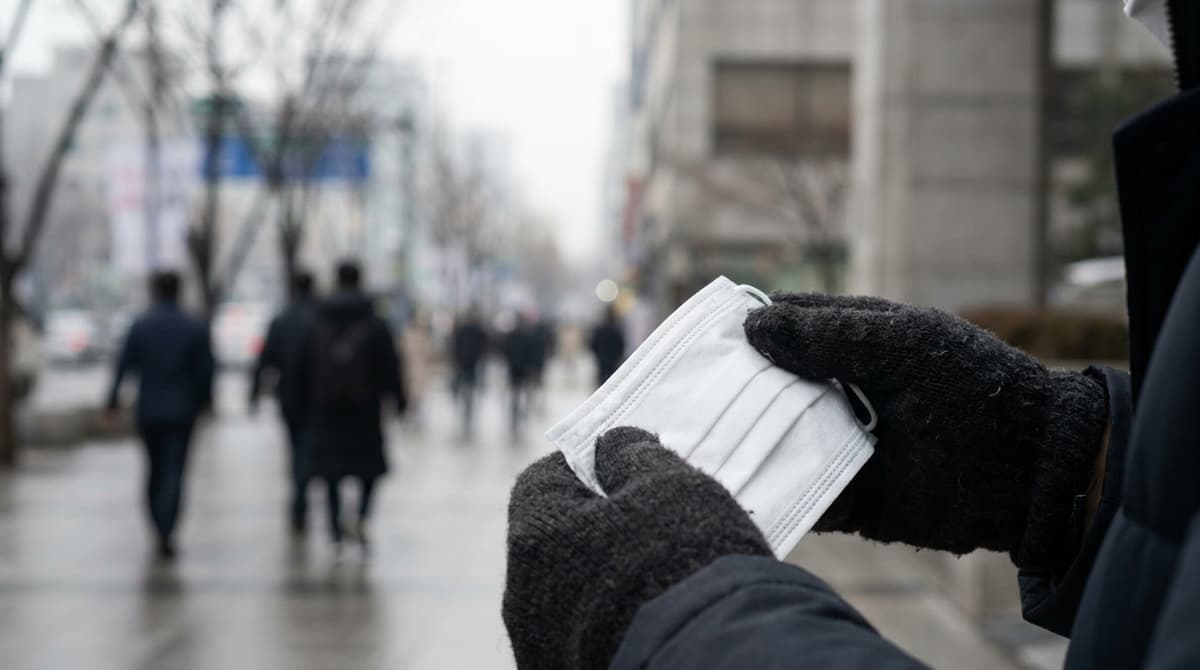
A higher number means harder breathing, so pick by the day and by you. Health guidance from Korea's disease control agency and medical groups says KF80 is enough for daily life. Healthy adults can go without a mask up to about 50 µg/m³; older adults, pregnant women and people with heart or lung conditions should wear one outdoors from 36. Masks are sold at every convenience store, pharmacy, Daiso and on Coupang, and are cheaper by the box.
Look for 의약외품 (quasi-drug) and the KF mark on the packet. Press the nose wire to seal it, don't stuff a tissue inside, and don't wash or reuse it. Take it off if you get short of breath or a headache.
Ventilating a One-Room on Bad Days
Shutting your windows all winter is not the answer. Indoor air collects carbon dioxide, cooking smoke and chemicals from furniture, and in a small one-room it builds up quickly. The joint guidance from the disease control agency and medical groups:
- Good or moderate days: open the windows three times a day for 30 minutes or more.
- Bad days: still ventilate three times a day, for about 10 minutes.
- After cooking: run the range hood and ventilate for 30 minutes whatever the outdoor reading. Grilling meat or frying fish in a closed one-room raises indoor particles sharply.
Daytime is better than early morning, when the air is most stagnant, and a window away from the road is better than one facing it. Ventilation also fights the other winter problem in Korean flats: condensation and black mold. Keep indoor humidity around 40 to 60 percent; our winter mold and condensation guide explains why a sealed, heated room grows mold, and our winter-proofing guide shows how to stop drafts without sealing the room completely.
💡 TIP: Open two windows on opposite sides, or a window and the front door, for 5 to 10 minutes. A cross draft swaps the air faster than one window open for half an hour, and the floor stays warm.
Rent or Buy an Air Purifier?
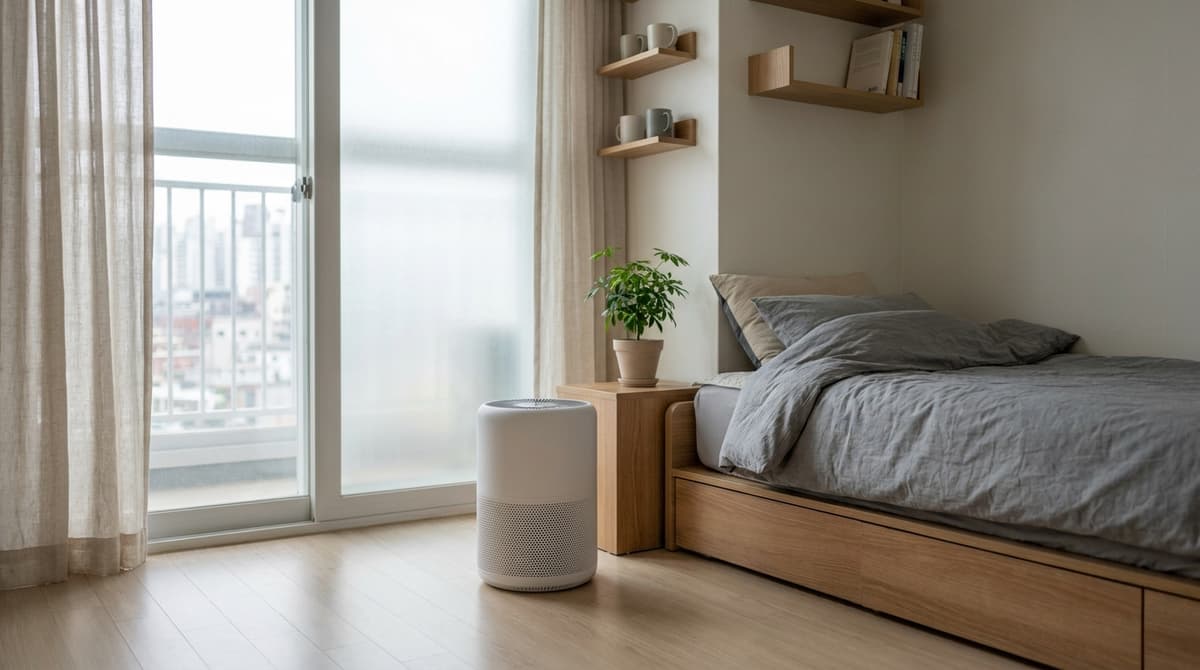
Most Koreans rent their purifiers (렌탈) from Coway, LG or SK, with filter changes and a visiting technician included. On a broker site this October, monthly rentals started at about 18,800 KRW for a small LG model, 25,400 KRW for a Coway model rated for 24 pyeong (about 80 m²), and up to about 50,000 KRW for large units. Prices depend on the contract length and card discounts.
Watch the contract length. Rentals come with a minimum term of several years, and cancelling early means a penalty. For a one-year stay, buying a compact purifier outright is usually cheaper. Use a rental only if you are staying long-term or the landlord's place already includes one.
- Size it right: the Korea Consumer Agency recommends a rated area of about 1.3 times your room, more if you want it to clear the air fast on yellow dust days. A one-room of 20 m² (about 6 pyeong) needs a purifier rated for 8 pyeong or more.
- Change the filter: roughly every 6 to 12 months; the manufacturer's app will tell you.
- Be careful with cheap compatible filters. In a Korea Consumer Agency test published in July 2026, 16 of 20 non-brand replacement filters failed to remove harmful gases properly, and 12 removed less dust than their labels claimed.
Run the purifier after you ventilate, with windows closed, and put it where air can move around it, not in a corner behind furniture.
The Winter Rules You Might Notice
From December to March the government runs its seasonal fine dust management system (미세먼지 계절관리제). The seventh season ran from December 1, 2025 to March 31, 2026, with coal power plants turned down and large factories cutting emissions. The eighth season is expected on the same dates, with the plan due in late November.
If you drive, this affects you. During the season, old diesel vehicles rated emission grade 5 without a filter are banned from Seoul on weekdays from 06:00 to 21:00, with a fine of 100,000 KRW a day. Inside the old city walls, the Green Transport Zone bans them all year with a 250,000 KRW fine. Our driving in Korea guide covers the rest of the rules.
On the worst days the government issues emergency reduction measures (비상저감조치), announced at 17:00 for the next day. You will see restrictions on public-sector cars and shorter construction hours. Schools stay open, but outdoor classes are cancelled during an advisory.
Who Should Be More Careful
The disease control agency lists people with heart or blood vessel disease, asthma and other respiratory or allergy conditions, pregnant women, children and older adults as sensitive groups. On bad days, skip hard outdoor exercise, stay away from main roads and construction sites, swap contact lenses for glasses, and wash your hands and face when you get home. If you have asthma, ask your doctor for a plan before March; our NHIS guide explains how much a clinic visit costs with national health insurance.
Get the app, keep a box of KF80s by the door, and keep opening the windows.
Looking for a room with better air? Homes in Korea helps foreigners find furnished rooms and monthly rentals across Seoul, so you can ask about ventilation, window direction and appliances in English before you sign.