The first cold snap usually shows you where the draft comes in: the window that whistles, the gap under the front door, the floor that is warm while your face is cold. Koreans fix most of it in one trip to Daiso before the boiler bill arrives.
Last updated: October 26, 2026 (KST)
Here is the bottom line. Bubble wrap on the glass (dan-yeol ppokppogi, 단열뽁뽁이) does the most, door and window strips (munpungji, 문풍지) close the gaps, and a blackout curtain covers the rest. At Daiso prices that is about 20,000 KRW (about $15) for a typical one-room, and it can raise the room 2 to 3 degrees. A plug-in space heater is the expensive option: a 2,000 W heater run four hours a night can add about 57,000 KRW (about $42) to a month's power bill. Insulate first, then let the boiler do the heating.
Where the Cold Gets In
Windows are the weak point. A researcher at Korea Conformity Laboratories told SBS that about 40 percent of a building's heat loss goes through the windows, and Korean building code values from 2011 put a typical apartment window at six to seven times the heat loss of the wall around it.
Older one-rooms and villas often have aluminium sliding frames, and the frame itself leaks: a 2011 study of a university building measured an aluminium frame without a thermal break at a U-value of about 9.6, against about 2.4 for the double glass in it. Newer buildings use PVC double windows, which hold heat far better. Either way, the three leak points are the same: the glass, the gaps where the sashes meet, and the gap under the front door.
💡 TIP: Find the drafts on a windy evening. Hold a lit candle or a strip of tissue along the window edges and the bottom of the front door, and mark every spot where it moves.
What Actually Works, Measured
The cleanest side-by-side test is still an SBS News experiment from January 2013. Identical rooms were heated to 16 degrees, the heaters were switched off, and the temperature was read an hour later with sub-zero weather outside.
| Treatment | Room temp after 1 hour | Gain over bare glass |
|---|---|---|
| Nothing | 7.0°C | none |
| Door and window strips | 7.2°C | +0.2°C |
| Curtain | 7.5°C | +0.5°C |
| Window film | 7.7°C | +0.7°C |
| Bubble wrap | 9.2°C | +2.2°C |
SBS called bubble wrap the best value of the lot, with strips worth adding on old, leaky frames. A Korea Energy Agency regional director wrote in 2021 that strips and window film together raise a room about 3 degrees, and that all winter measures combined cut heating by 20 to 30 percent. Each degree you lower the thermostat saves about 6 percent of heating energy, which is where the money comes back.
Your Daiso Shopping List
Prices below were listed on Daiso's online mall on October 26, 2026. Some items sell out online by November, so check your local store too.
- Bubble wrap for glass: the 100 by 220 cm window insulation sheet (유리단열시트) and the self-adhesive insulation sheet (자가점착형 단열시트, 2 m) are 3,000 KRW (about $2.20) each. The 100 cm by 3 m bubble roll (뽁뽁이 단열 시트) and the blackout bubble sheet are also 3,000 KRW but were sold out online. Buy one per window pane.
- Window and door strips: urethane foam strips (우레탄 문풍지) run 1,000 to 2,000 KRW by thickness, pile strips (털실 문풍지) are 1,000 KRW, and clear strips (투명 문풍지) are 3,000 KRW. Outdoor-grade strips are 2,000 KRW for 2 m.
- Door gap blockers: the E-type twin door sweep (E형 문틈막이, 2 lines) and the D-type (문틈막이 D형) are 3,000 KRW each.
- Draft film kit: the special draft-blocking film (특수 외풍차단 필름) is 3,000 KRW medium and 5,000 KRW large, for covering a whole window you never open.
- Blackout curtain: every listed size, from 140 by 160 cm to 140 by 240 cm, is 5,000 KRW (about $3.60). A floor-length one traps more air than a short one.
A typical one-room with one big window, one small window and a front door comes to about 20,000 KRW. Coupang sells 10 to 20 m bubble wrap rolls if you have more glass to cover.
How to Fit It Without Losing Your Deposit
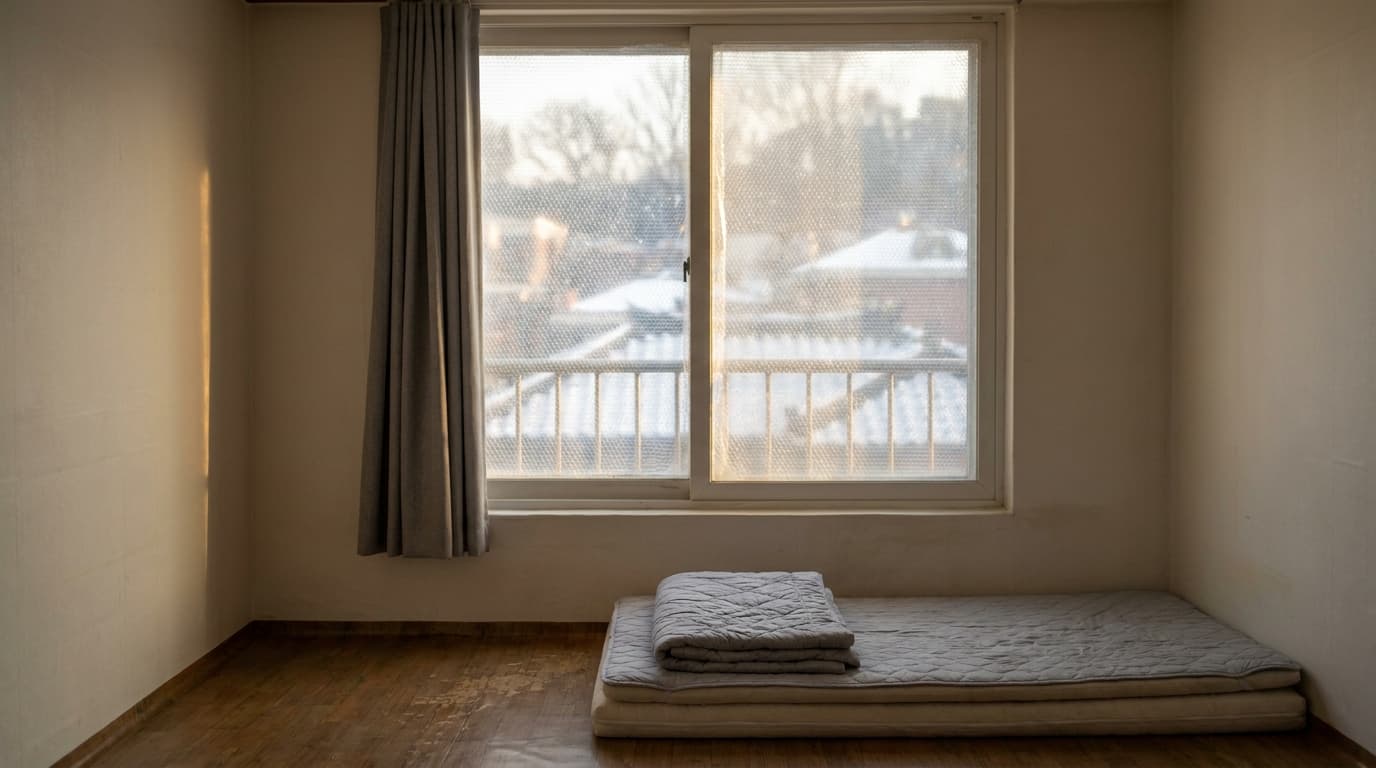
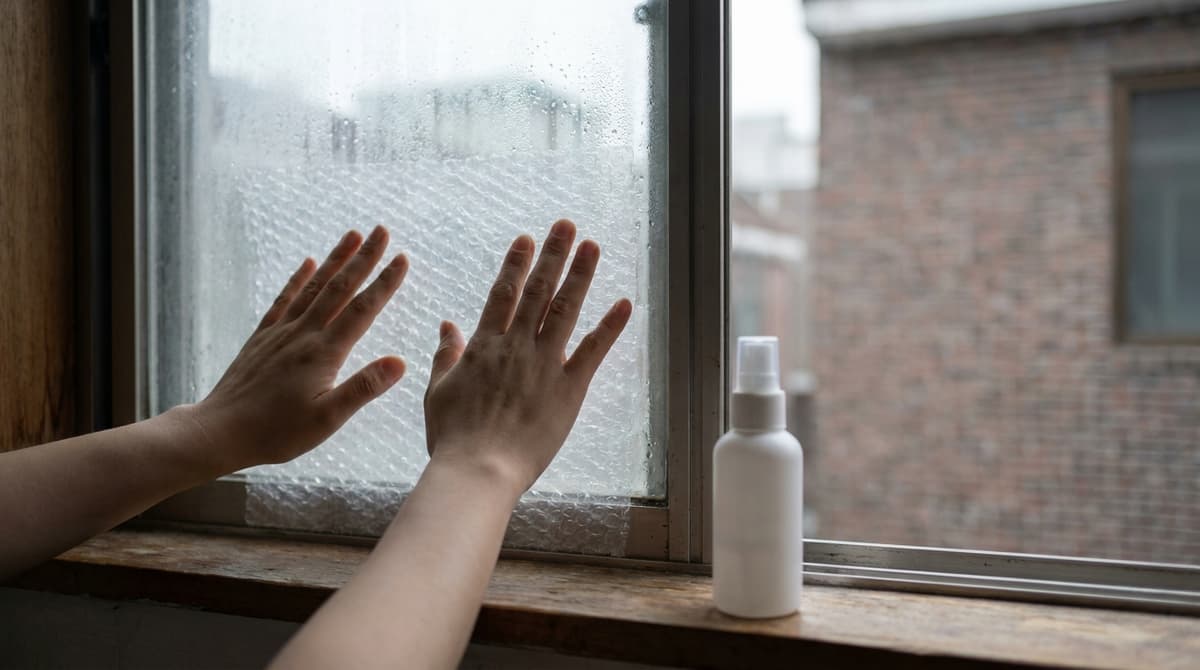
Bubble wrap. Put it on the inside of the glass, never the outside; the Ministry of Climate, Energy and Environment's winter campaign also says two layers beat one and covering the whole pane cuts more loss. The common method is to mist the glass with water, press the flat side of the wrap against it and smooth out the air, then trim the edges. Water holds it for the season and peels off clean. Self-adhesive sheets stick faster but can leave residue.
Two warnings from overseas experts: don't stick bubble wrap on wire glass (망입유리, the kind with a mesh inside), which can crack, and don't spray water on glass that is already freezing.
Strips. Clean and dry the frame first or the foam will lift within a week. Stick foam strips where the two sliding sashes overlap and along the frame edge, then slide the window to check it still closes. Pile strips suit sliding contact points; foam suits gaps that close with pressure.
Front door. Fit the sweep to the inside bottom edge so it brushes the floor when the door closes.
Your deposit. The standard Korean lease (주택임대차표준계약서) says tenants restore the home at move-out but are not responsible for normal wear and tear, and it bars structural changes without the landlord's consent. Strips and film are not structural, but glue marks on a frame can turn into a deduction. Use water-mount bubble wrap where you can, ask the landlord before using adhesive, peel everything off before your final inspection, and take dated photos at move-in and move-out. If a broken window seal or a failed boiler is the real cause of the cold, that is the landlord's repair under the lease, not yours.
💡 TIP: Bubble wrap holds moisture against the glass, so the window will drip more. Wipe the sill every morning and air the room for 10 minutes once a day. Our winter mold and condensation guide covers what to do when the corners turn black.
The Space Heater Question
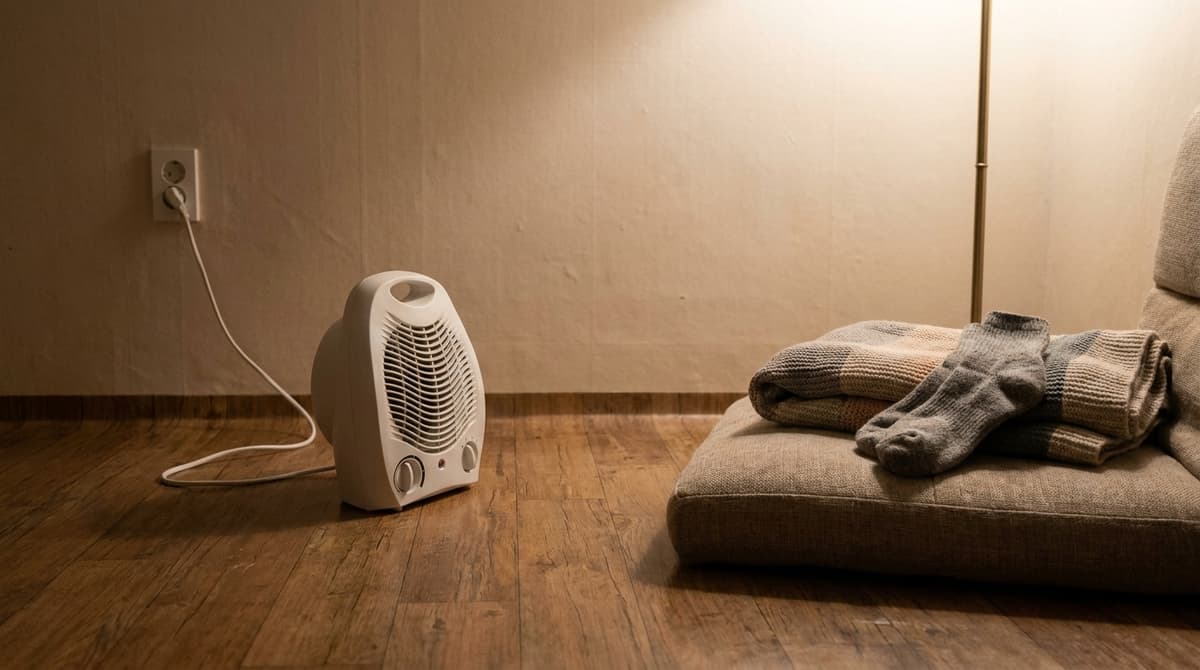
A small heater by the desk feels like the obvious fix. On a Korean power bill it usually is not.
KEPCO charges homes in tiers outside July and August. The first 200 kWh a month cost 120 KRW per kWh, use from 201 to 400 kWh costs 214.6 KRW, and above 400 kWh it is 307.3 KRW, with the basic charge also jumping from 910 to 1,600 to 7,300 KRW. Add the 9 KRW climate charge, the 5 KRW fuel-cost adjustment (frozen for Q4 2026), 10 percent VAT and the 2.7 percent power fund, and each kWh costs about 151 KRW in Tier 1 and 258 KRW in Tier 2.
For a typical one-room using 150 kWh a month:
- Without a heater: about 23,700 KRW (about $17).
- With a 2,000 W heater, 4 hours a night for 30 nights: 240 kWh more, 390 kWh total, about 81,000 KRW (about $59). The heater alone adds about 57,000 KRW, roughly 480 KRW an hour.
- Smaller heaters: at the Tier 2 rate, an hour costs about 155 KRW at 600 W, 258 KRW at 1,000 W and 386 KRW at 1,500 W.
A gas boiler heats the same room for much less. Residential gas has stayed frozen through 2026, and a rough estimate puts boiler heat at about 95 to 105 KRW per useful kWh, against 151 to 362 KRW for an electric heater depending on your tier. Our boiler guide explains the settings, and our heated mat comparison shows how to keep your bed warm for a few thousand won a month. Keep a heater for short bursts: drying off after a shower, or a desk at midnight.
If you do buy one, be careful. The Ministry of the Interior and Safety counted 2,390 electric heater and mat fires from 2018 to 2022, with 48 deaths, and 42 percent of them happened in December and January. Buy a model with a KC mark that cuts off when tipped over, plug anything around 2,000 W straight into the wall rather than a power strip, and keep blankets and laundry well away. Goshiwon and most dormitories ban heaters outright, so ask first.
Before the First Hard Freeze
Your water meter is the other thing winter breaks. Seoul issues four freeze alert levels by the daily low: watch above minus 5 degrees, caution from minus 5 to minus 10, alert below minus 10 for two days or more, and severe at minus 15 or below for two days or more. In Seoul water tests, an uninsulated mechanical meter broke after about 8 hours at minus 5 and in under 5 hours at minus 10.
- Pack the meter box. Stuff it with dry insulation or old clothes and cover the lid with plastic film. About 70 percent of frozen meters had no insulation.
- Run the tap on cold nights. From minus 5 to minus 10, leave a trickle that fills a paper cup in about 45 seconds; below minus 10, about 33 seconds. Ten hours of it costs under 300 KRW.
- Leave the boiler on low when you travel. Long absences cause about a quarter of frozen meters.
- Photograph the insulation. Seoul replaces meters frozen by severe cold, but if the box was not insulated or was damaged, the user pays about 41,000 KRW for a standard 15 mm meter. Tenants who could not prove they insulated have been billed in full.
If it freezes anyway, call 120 (Dasan Call Center) or message the Arisu Talk (아리수톡) KakaoTalk channel, and thaw the pipe slowly with warm air, never boiling water.
Wear It, Then Heat It
The Ministry of Climate, Energy and Environment recommends keeping homes at 20 degrees in winter, and says socks and thermal underwear make you feel about 3 degrees warmer. Close the bedroom door so the heat stays where you sleep, lay a rug or blanket on cold tiles, and run a humidifier while the boiler is on; dry air feels colder than it is. The rest of a Korean winter wardrobe is in our what to wear by temperature guide.
A drafty window is not a reason to move, but it is worth knowing about before you sign. Ask the landlord which way the windows face, whether they are double-glazed, and what last winter's gas bill came to.
Looking for a one-room that is already warm? Homes in Korea helps foreigners find furnished rooms and monthly rentals across Seoul, with heating and utilities explained in English.