Sometime in late November, a message will arrive in your team chat with a date in December and the word 송년회 (songnyeonhoe). It means "seeing off the year," and it is the Korean year-end party, held by companies, teams, university clubs and groups of friends. For many foreigners it is the first big 회식 (hoesik, company dinner) of their Korean working life, and the one with the most unwritten rules.
Last updated: November 16, 2026 (KST)
The good news is that the year-end party has changed a lot in the last few years. Lunch parties, one-round dinners and nights with no drinking at all are now normal. Here is what to expect, the drinking etiquette that still matters, how to turn down alcohol without awkwardness, and how to get home afterwards.
What Songnyeonhoe Looks Like Now
The most recent numbers come from an Incruit survey of 888 office workers in late 2025:
- 69.7 percent said their company was holding a year-end party, rising to 75.7 percent at large companies.
- Of those, 69.8 percent said attendance was up to them. At large companies it was 83.3 percent, at small and medium firms 62.8 percent.
- 58.8 percent said a year-end party was necessary, but only 47.5 percent of people in their 20s agreed, against 68.9 percent of those 50 and over.
- Workers in their 20s and 30s mostly wanted a party during working hours with a meal only. Those in their 40s and 50s preferred an evening with drinks.
Asked what the party should include, 32.8 percent picked a meal and coffee, 31.9 percent a meal and drinks, and 28.8 percent a meal only. So about three in five would rather not drink at their year-end party.
Big companies have been shrinking the ceremonies too. In December 2024, Samsung, SK, Hyundai, LG and POSCO held no separate 종무식 (jongmusik, year-closing ceremony), and several encouraged staff to use up their leave. The 시무식 (simusik, opening ceremony) in early January still happens at many firms.
Three words you will hear
- 송년회 (songnyeonhoe): the year-end party.
- 망년회 (mangnyeonhoe): an older word meaning "forget the year." It comes from the Japanese bōnenkai, and the National Institute of Korean Language recommends 송년회 instead, so some people avoid it.
- 신년회 (sinnyeonhoe): the New Year's party in January, often with the same people.
How the Evening Usually Goes
The traditional company dinner runs in rounds, called 차 (cha):
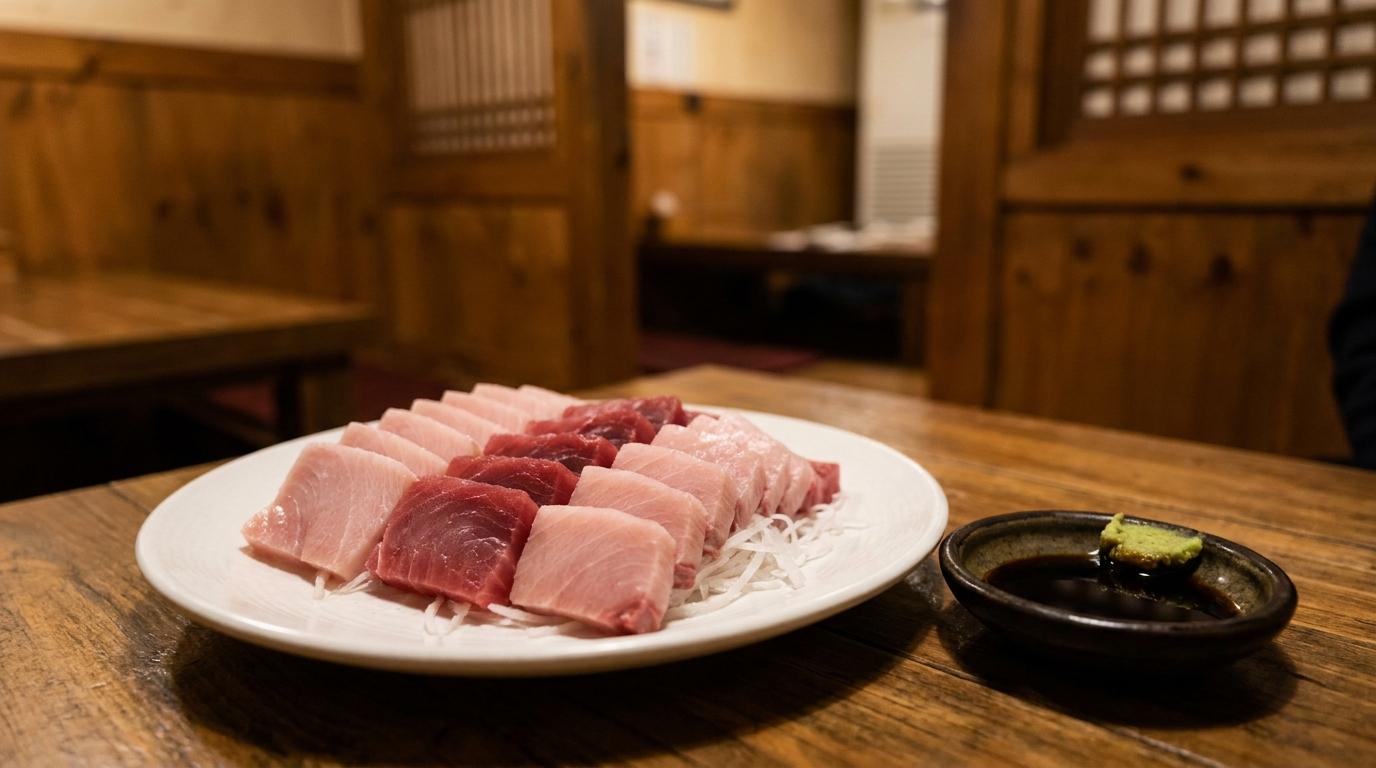
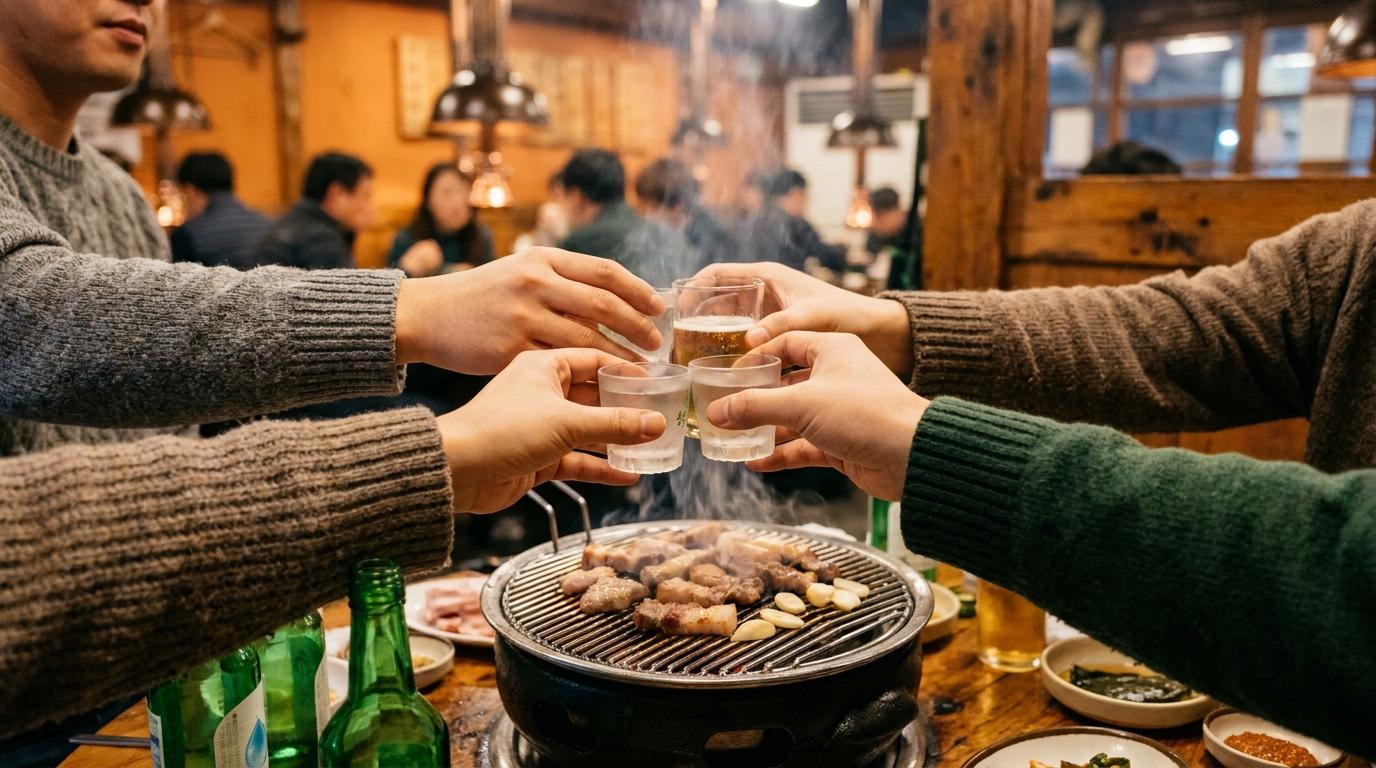
- 1차 (il-cha), first round: dinner, usually Korean barbecue, sashimi or a set menu, with soju and beer. The company card normally pays.
- 2차 (i-cha), second round: a pub or a bar for more drinks and snacks.
- 3차 (sam-cha), third round: 노래방 (noraebang, karaoke) or another bar.
At most offices now, the first round is the only one that matters. Samsung's often-quoted "119" rule sums up the trend: one kind of alcohol, one round, done by 9 pm. Leaving after the first round is normal. A simple 먼저 들어가 보겠습니다 (meonjeo deureoga bogetseumnida, "I'll head home first") to your manager is enough.
The party is often split into team dinners rather than one huge event. In the Incruit survey, about half of those whose company held a party said it was company-wide and 37.8 percent said it was just their team.
The toast
Someone senior usually gives a short speech and leads a 건배사 (geonbaesa), a toast with a call and response. The simplest is 위하여 (wihayeo, "to us"), with everyone shouting it back. You will also hear wordplay toasts, such as:
- 119: one drink, one round, home before 9.
- 9988 1234: live healthily to 99 (구구, gugu, sounds like 99, 팔팔, palpal, means "lively"), be ill for one, two, three days, and die on the fourth (사, sa, four, sounds like the word for death).
- 청바지 (cheongbaji, "jeans"): short for 청춘은 바로 지금, "youth is right now."
- 이기자 (igija, "let's win"): short for "let's make occasions like this more often."
If you are new, someone may ask you for a toast. A short thank you in Korean or English followed by 위하여 is more than enough, and colleagues usually find it charming.
Drinking Etiquette That Still Matters
Korean drinking manners are about age and seniority. You do not need to get them perfect, and most Koreans are relaxed with foreigners, but these are the ones people notice:
- Pour for others, not yourself. Fill your seniors' glasses when they are empty, and let someone else fill yours.
- Use two hands. Hold the bottle with both hands, or with one hand and the other touching your wrist or forearm, when pouring for someone older. Hold your glass with two hands when someone senior pours for you.
- Turn away to drink. When you drink in front of someone much older or senior, turn your head slightly to the side.
- The first glass. It is common for everyone to at least raise the first glass together, even if you only touch it to your lips.
- An empty glass means "fill me." If you want to slow down, leave about a third in your glass.
Some offices have officially dropped the old customs. Some companies have banned forced toasts and 잔 돌리기 (jan dolligi), passing one glass around the table, and declining either is now widely accepted.
How to Say No to a Drink
Drinking in Korea is falling, especially among younger people. Total alcohol shipments fell from 3.8 million kilolitres in 2015 to 3.15 million in 2024, and CU convenience stores reported highball sales up 315.2 percent in 2024 as people moved to lighter drinks. Saying no is a lot less awkward than it used to be.
The trick, according to Korean workers themselves, is to say it early, before the first glass is poured. A few lines that work:
- 요즘 약을 먹고 있어요 (yojeum yageul meokgo isseoyo), "I'm on medication these days."
- 내일 아침 일찍 중요한 미팅이 있어요 (naeil achim iljjik jungyohan miting-i isseoyo), "I have an important meeting early tomorrow."
- 오늘 운전해야 해서요 (oneul unjeonhaeya haeseoyo), "I'm driving today." Everyone accepts this one immediately.
- 저는 술을 못 마셔요 (jeoneun sureul mot masyeoyo), "I can't drink." If it is true, it is the cleanest answer.
Other tricks Korean workers use: keep a glass of water or a soft drink beside your glass, sit away from the heaviest drinkers, and offer to grill the meat, which keeps your hands busy.
What the law says
Forcing someone to drink or to attend a company dinner against their will can count as 직장 내 괴롭힘 (workplace harassment) under Article 76-2 of the Labor Standards Act, according to the Ministry of Employment and Labor's harassment manual, which was revised in July 2026. In a 2025 survey by the labor group 직장갑질119, 33 percent of workers said they had experienced workplace harassment in the past year, and 15.4 percent of those cases involved being forced into dinners, drinking, karaoke or talent shows.
If it happens, you can report it to your company, and if the company does nothing, to your regional Ministry of Employment and Labor office. Under 2018 ministry guidance a company dinner generally does not count as working time, but Korean courts have recognised injuries at employer-hosted dinners as industrial accidents.
What People Dislike Most
In a 2024 survey by Handok's hangover brand Ready Q (124 workers, a small sample), the most disliked part of company dinners was forced performances such as singing or dancing, 장기자랑 (janggijarang), at 48 percent, followed by forced drinking at 22 percent. The most popular finishing time was 9 pm, picked by 44 percent. Another survey, by Chosun Ilbo and Tillion Pro, put lectures from senior staff above drinking, toasts and singing as the worst part of a year-end party.
So if your team asks for a talent show, it is fine to politely sit it out. If they hold a 마니또 (manito, secret Santa) gift exchange instead, the usual budget is set in advance, so just ask.
Getting Home After the Party
Seoul usually adds late buses in December, but plan your way home before you start drinking.
Never drive. The legal limit in Korea is a blood alcohol content of 0.03 percent. Between 0.03 and 0.08 percent your licence is suspended and you face up to a year in prison or a fine of up to 5 million KRW; from 0.08 percent your licence is revoked and the penalties go up from there. If you drove to work, use 대리운전 (daeri unjeon), a designated driver service that drives your car home for you. There is no fixed fare; apps such as Kakao T show a price before you book, and December nights are more expensive.
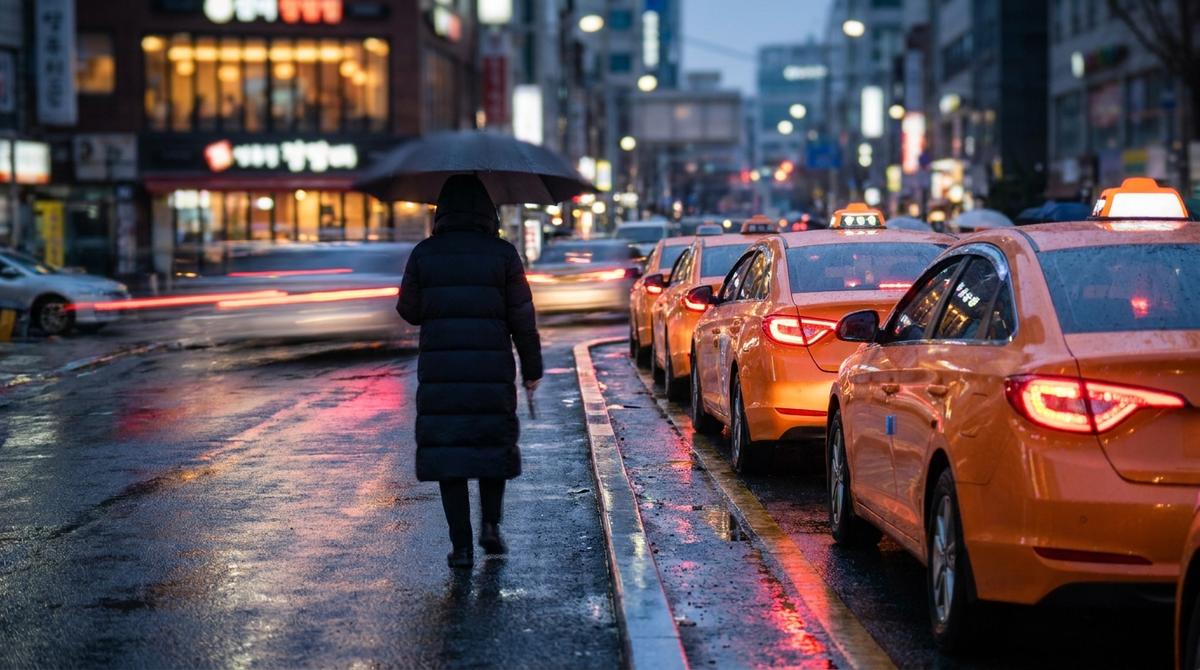
Taxis. Seoul's base fare is 4,800 KRW. A night surcharge of 20 percent applies from 22:00 to 23:00 and 02:00 to 04:00 (base fare 5,800 KRW), and of 40 percent from 23:00 to 02:00 (base fare 6,700 KRW). Taxis are hard to catch around 23:00 near Gangnam and Jongno, so book one in Kakao T a little early.
Subway and buses. On weekdays the subway runs until around 1 am at the terminal stations, earlier on weekends and holidays. Check your own line's last train in the Kakao Metro or Naver Map app. Last December the city extended 87 bus routes from 11 major stops, including Gangnam, Jongno 2-ga, Hongik University and Yeouido, to run until 1 am from December 15 to 31, and added 28 extra owl buses (올빼미버스). Look for a similar announcement in early December.
The Morning After
Korea has a whole industry for the next day. Convenience stores sell hangover drinks and sticks such as Condition, whose stick version went up to 3,900 KRW in January 2025, and 여명808 (Yeomyeong 808). At lunch, coworkers will head for 해장국 (haejangguk), "hangover soup," often a beef bone broth with napa cabbage, or a lighter bean sprout soup (콩나물국밥). Asking 해장하러 가실래요? (haejanghareo gasillaeyo, "Want to go for hangover soup?") is a very Korean way to bond the day after.
Year-End Parties With Friends
Not every songnyeonhoe is a work event. Friends and clubs book restaurants, karaoke rooms or 파티룸 (party rooms), private rooms rented by the hour in areas such as Hongdae, which are popular for home-style parties with a projector and a kitchen. Prices depend on the day and group size, many have a two or three hour minimum, and the Saturdays before Christmas go first, so book early. Home parties have grown too: Korean fashion platform Zigzag reported sales of home wear and party goods up to six times higher last year-end among women in their 20s and 30s.
If your first year-end party is also your first December in Korea, our Christmas in Korea guide covers the rest of the season, and our Korean drinking culture guide explains soju, makgeolli and traditional liquor.
Starting a job in Seoul? Homes in Korea helps foreigners find furnished rooms and monthly rentals close to work, with the lease terms explained in English, so the ride home after the party is a short one.
You might also like