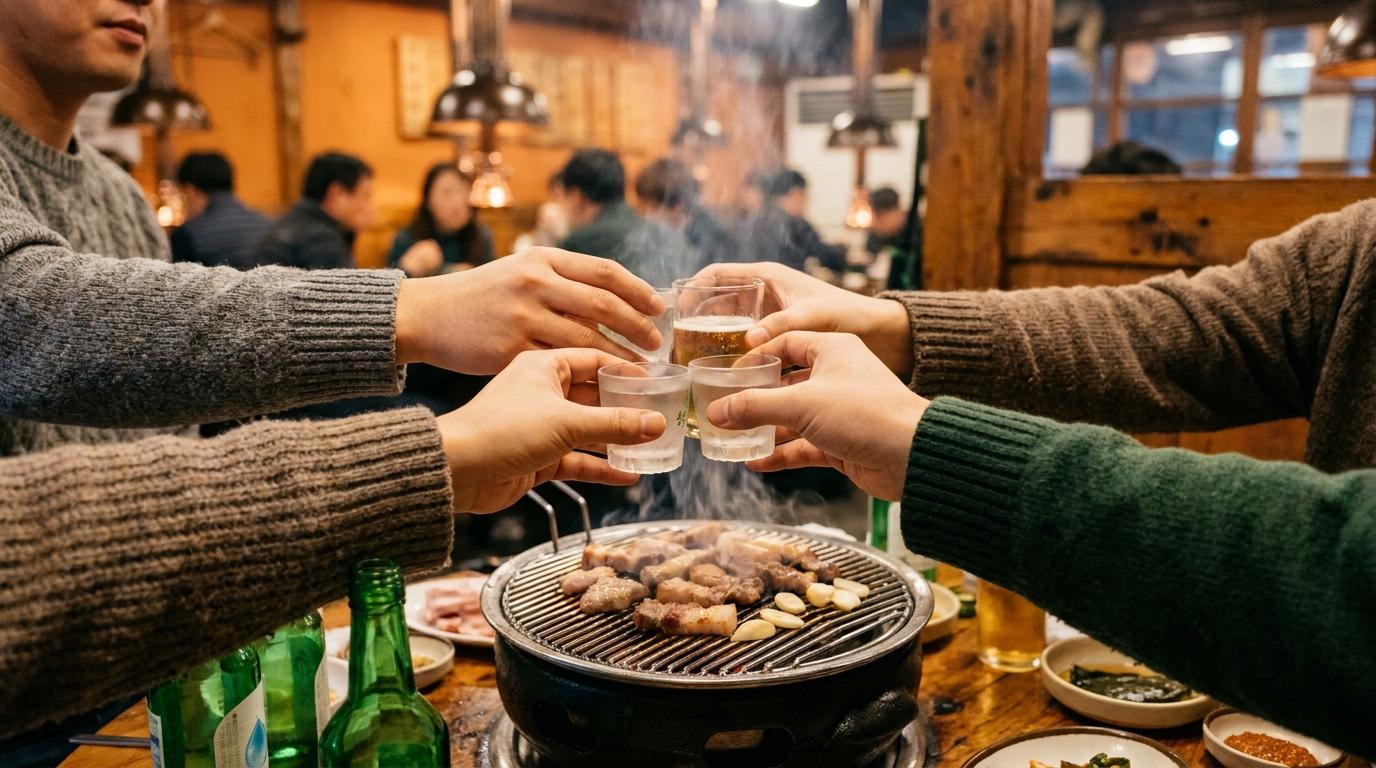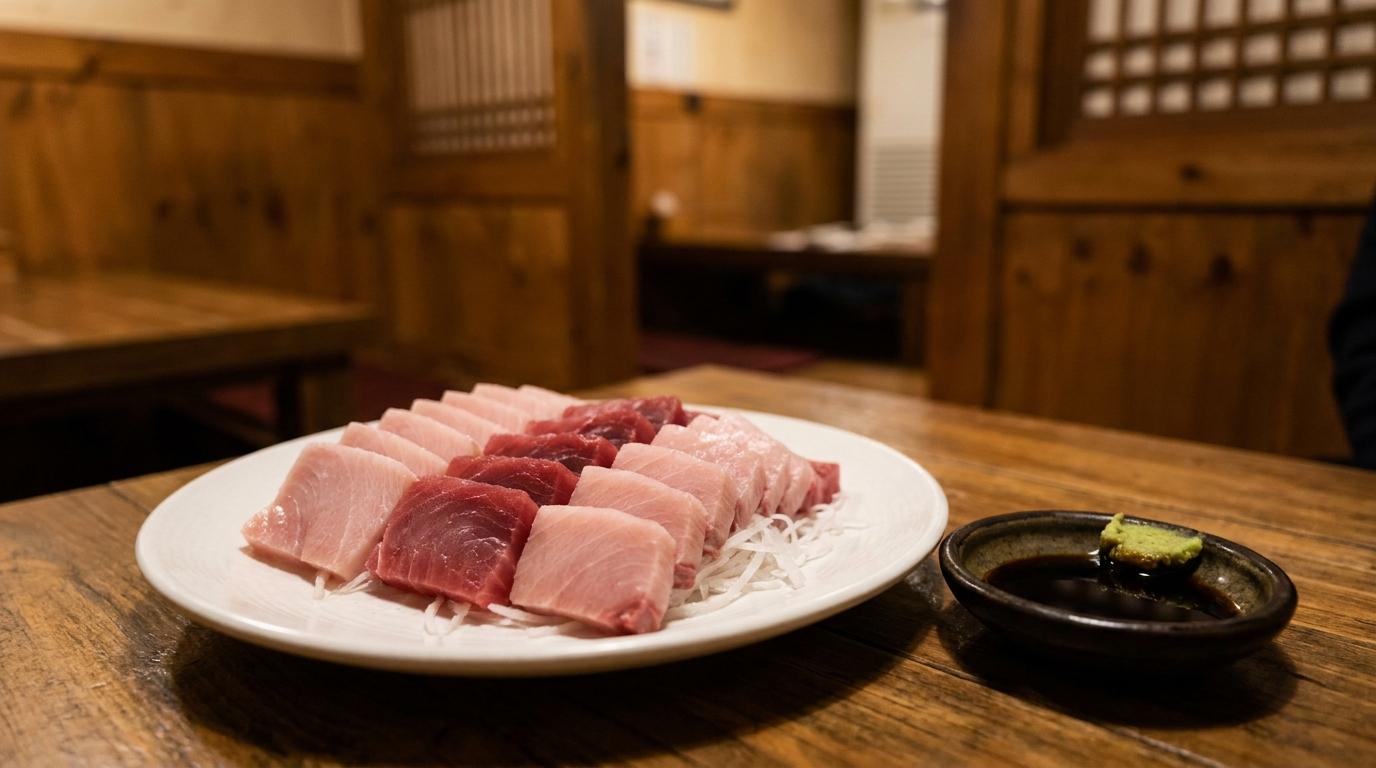
When the temperature in Seoul drops below zero for the first time, two words start appearing on restaurant windows and in Korean group chats: 방어 (bangeo) and 과메기 (gwamegi). Bangeo is yellowtail, eaten raw in thick slices, and the bigger the fish, the fattier and more prized it is. Gwamegi is saury left to dry in the sea wind until it turns chewy, wrapped in seaweed with garlic and chili. Both are winter-only and both go with soju, and sooner or later a Korean coworker will ask if you have tried them.
Last updated: November 16, 2026 (KST)
Below is when each one is at its best, what prices look like this year, how to buy bangeo at Noryangjin Fish Market without getting lost, and where to eat it in Seoul if you would rather just sit down and order.
Bangeo, the Winter Yellowtail
Bangeo swims south along the Korean coast as the sea cools, and once the water drops below about 18°C in November it comes close to shore. The traditional fishing grounds are Jeju and the South Sea around Tongyeong, Geoje and Wando, and in recent years the East Coast of Gangwon Province has become a major catch area too, because the sea there has warmed. The Ministry of Oceans and Fisheries lists December and January as the tastiest months.
Size matters more than anything else with bangeo. The Ministry of Food and Drug Safety uses these grades:
| Grade | Weight | What it means at the table |
|---|---|---|
| 소방어 (so-bangeo, small) | 3 to 6 kg | Leaner, cheaper, fine for a first try |
| 중방어 (jung-bangeo, medium) | 6 to 8 kg | A good middle ground |
| 대방어 (dae-bangeo, large) | 8 kg and up | The one everyone queues for, with a fat belly |
You will see other numbers in shops and blogs, some calling anything over 6 kg "large," so ask the weight rather than trusting the label. A fish over 8 kg can be around 20 percent fat, which is why the belly of a 대방어 tastes almost buttery.
The cuts
A big bangeo is broken down into several parts, and good restaurants will serve a mix on one plate:
- 등살 (deungsal, back): redder and leaner. Eat this first, before the richer cuts.
- 뱃살 (baetsal, belly): the fattiest part and the reason people pay for a large fish.
- 사잇살 (saitsal): the meat between back and belly, lean with a texture close to beef tartare.
- 가마살 (gamasal, collar): a triangular piece from behind the head, fatty and firm.
- 배꼽살 (baekkopsal, "navel"): the chewy lower belly, usually only worth it on a 대방어, often eaten with sesame oil and salt.
Bangeo is easy to confuse with 부시리 (busiri, yellowtail amberjack), which looks similar but is a summer fish. Bangeo has a more angular jaw and tail and redder flesh. At a reputable stall this will not be a problem, but it is why some people ask.
What Bangeo Costs This Year
Bangeo prices move every day with the catch, the origin and the size, so treat the numbers below as a guide and not a menu.
The East Coast is having a big year. Gangwon Province reported 2,524 tonnes landed by early November 2026, 145 percent of the same point last year. Prices have still gone up, because demand has gone up faster. At the Noryangjin auction on November 5, 2026, live bangeo from Goseong sold for 20,900 KRW per kg, against 8,000 KRW a year earlier, and live bangeo from Donghae sold for 25,100 KRW per kg. Traders quoted by Economist Korea have said peak prices in December and January could reach as much as three times last year's.
Those are wholesale auction prices. What you pay at a stall is higher. For reference, last season looked like this:
- Early November 2025: asking prices at Noryangjin stalls ran from 28,000 to the mid 30,000s KRW per kg.
- December 9, 2025: domestic bangeo at auction neared 50,000 KRW per kg, and a 10 kg 대방어 approached 500,000 KRW wholesale.
- Restaurants, December 2025: a large plate of 방어회 (bangeo-hoe, bangeo sashimi) often cost over 100,000 KRW, and four people with sides and drinks could spend around 300,000 KRW.
A rough rule from Korean press: 1 kg of fish makes about two servings of sashimi. Prices usually soften from mid-January into February as more fish comes in, so if you are watching your budget, the second half of the season is cheaper and the fish is still good.
How to Buy Bangeo at Noryangjin Fish Market
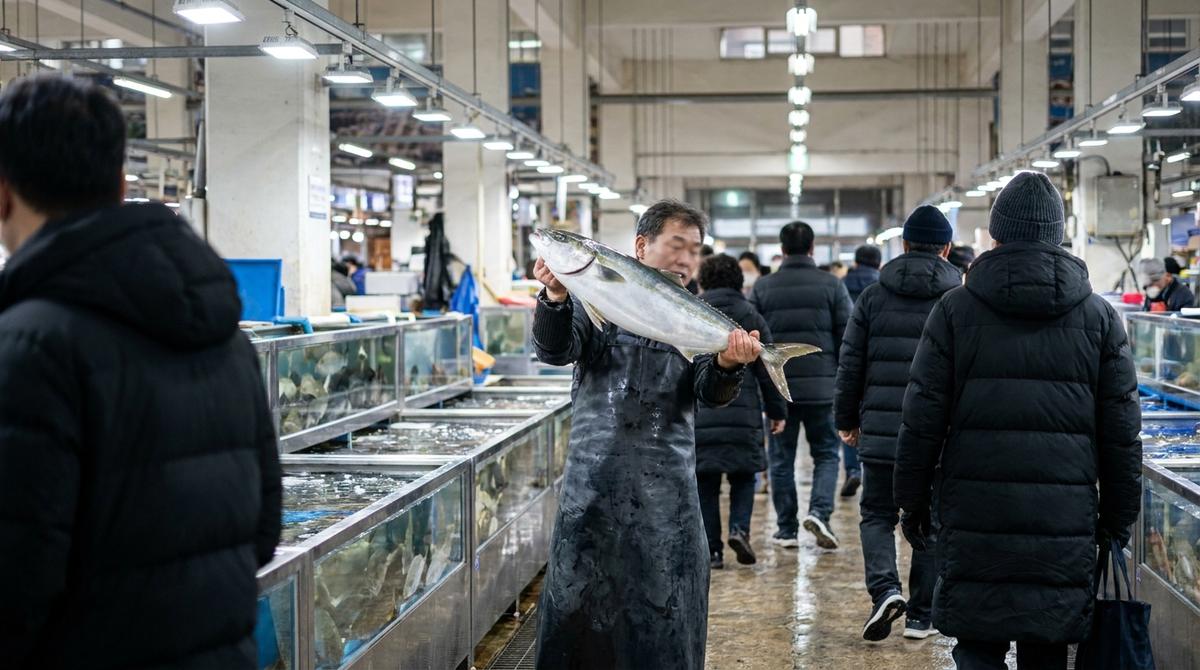
Noryangjin Fisheries Wholesale Market (노량진수산시장) is the classic place to do this, and it is less confusing than it looks once you know the system.
Getting there. The address is 674 Nodeul-ro, Dongjak-gu. Line 1 and Line 9 each have a Noryangjin station. From Line 1, take Exit 9 and walk about 150 m. From Line 9, take Exit 7 and follow the underground walkway. The general market runs from 1:30 am to 10 pm, and the high-end section is open 24 hours.
How it works.
- Walk the ground floor and compare stalls. Prices are usually per kg and written on a board.
- Pick your fish or ask for a bangeo platter for the number of people. Many stalls sell ready-cut 1 to 4 person sets now, which is easier than buying a whole fish.
- The stall cuts it and sends you upstairs to a partner restaurant (초장집, chojangjip).
- Upstairs you pay a table charge, 상차림비 (sangcharimbi), for the soy sauce, chili paste, lettuce and side dishes. It is commonly around 4,000 KRW per person, sometimes more if you skip the spicy fish stew, and every restaurant sets its own amount.
- Order 매운탕 (maeuntang), the spicy stew made from the leftover head and bones, to finish.
Tips that save money.
- Wednesdays are discount days, with 20 to 30 percent off domestic seafood and a coupon that covers the table charge for one person.
- Onnuri gift certificates (온누리상품권) get 10 percent off at stalls that accept them.
- Some wholesalers take cash only. There is a Suhyup ATM on the second floor of the new building.
- Haggle a little, but do not expect big discounts.
- The app 인어교주해적단 (Ineogyoju Haejeokdan) shows daily market prices and reviews, so you can check before you go.
If Noryangjin is far from you, Garak Market (가락몰) in Songpa works the same way and is easier for people living in southeast Seoul.
Where to Eat Bangeo in Seoul
If you want a table and a menu, these restaurants were recommended by Korean food magazines last December. Prices are for each restaurant's standard bangeo plate in December 2025 and have probably gone up. Popular bangeo restaurants have had two to three hour waits this month, so go early or book.
| Restaurant | Area | Bangeo price (Dec 2025) | Notes |
|---|---|---|---|
| 남산광어 (Namsan Gwangeo) | 26 Daesagwan-ro 34-gil, Yongsan-gu (Hannam) | 78,000 KRW | Also known for salt gimbap at 4,000 KRW |
| 숙성회 화도 (Hwado) | 5 Dongmak-ro 6-gil, Mapo-gu | 75,000 KRW | Aged sashimi; walk-in waitlist opens at 16:00, Catch Table bookings at 17:00 |
| 막회집 (Makhoejip) | 152 Magokseo-ro, Gangseo-gu (Magok) | 65,000 KRW | Good if you live near Magok or Gimpo |
| 서담해물 (Seodam Haemul) | 3-7 Dongmak-ro 15-gil, Mapo-gu, near Sangsu Station | From 38,000 KRW | The cheapest on this list |
| 더형제 (The Hyeongje), Nonhyeon | 110 Hakdong-ro, Gangnam-gu | Lunch set 50,000 KRW per person | Gangnam branch of a Noryangjin seafood shop |
A few other names come up again and again in Korean bangeo lists, without published prices: 바다회사랑 (Bada Hoesarang) in Yeonnam-dong, famous for long queues, 바다당 (Badadang) in Bangbae, 알배기 (Albaegi) in Mapo, and 보물섬 (Bomulseom) in Gangnam, which serves a large bangeo set with braised kimchi. Check Naver Map or KakaoMap for this year's menu and waiting list before you go.
Gwamegi, the Half-Dried Saury
Gwamegi is the other winter craving, and it divides people more than bangeo does. It is made by drying fish on open racks in the cold sea wind of Guryongpo, a fishing town in Pohang on the East Coast, until it is half dried, dark and chewy, with a rich, oily flavour.
It used to be made from herring, and the name most likely comes from 관목 (gwanmok), an old word for herring dried with its eyes skewered. Herring catches fell sharply in the mid 20th century and today over 90 percent of gwamegi is made from 꽁치 (kkongchi, Pacific saury), most of it caught in the North Pacific and shipped to Guryongpo to dry. The season runs from late October to around February. Pohang made 3,206 tonnes in the 2025-26 season, up 50.7 percent on the year before.
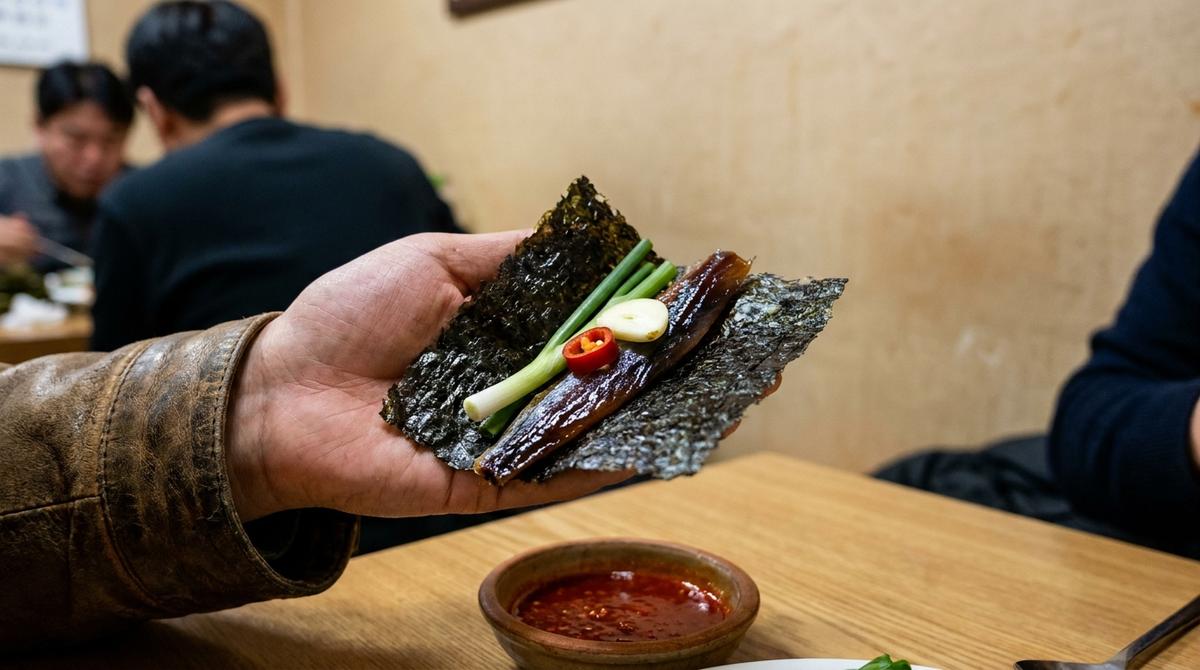
How to eat it. Gwamegi is almost always eaten as a wrap. Lay a strip on a sheet of dried laver (김) or raw seaweed (미역 or 다시마), add a piece of green onion, a slice of raw garlic and some chili, dip it in 초장 (chojang, sweet and sour chili paste), roll it up and eat it in one bite. Napa cabbage leaves are a common extra. Leaving it at room temperature for a few minutes softens the fat and takes the edge off the fishy smell.
What it costs. This season's opening price has not been reported yet. The 2025 season opened in Guryongpo on October 20 at 23,000 KRW for one 두름 (dureum), a bundle of 20 fish, about 2,000 KRW cheaper than the year before. Online, a 2026 Guryongpo set of 20 cleaned strips for two to three people was around 29,000 KRW in early November, and smaller packs with seaweed and vegetables included start around 15,000 KRW. Noryangjin, big supermarkets and online shops all sell it from November.
Storing it. Gwamegi keeps two to three days in the fridge. For longer, freeze it at minus 18°C or below.
The Guryongpo Gwamegi Festival in Pohang ran on November 7 and 8 this year, so it is over for 2026. If you want a weekend trip around fish instead, the 26th Southernmost Bangeo Festival (최남단 방어축제) runs from November 19 to 22, 2026 at Moseulpo Port in Seogwipo, Jeju. Organisers have announced bare-hand bangeo catching, net fishing and a bangeo auction, but not the timetable.
A Note on Raw Fish and Parasites
You may hear about worms in bangeo. The wriggling thread-like worm people sometimes find in a slice is usually 방어사상충 (bangeo sasangchung, Philometroides seriolae), a parasite of yellowtail muscle that Korean health reporting describes as unable to survive in humans. It looks alarming, but restaurants simply cut it out.
The one to take seriously with any raw fish is anisakis (고래회충). It is rare in bangeo muscle and less common in farmed fish. Korean fisheries and food safety authorities advise that it dies when frozen at minus 20°C for 24 hours or cooked above 60°C, and that thin slicing and good chewing help. If you get sharp stomach pain or vomiting within hours of eating raw fish, see a doctor; anisakis is removed by endoscopy, not treated with deworming pills.
If you are pregnant, have a weak immune system or a fish allergy, the cooked options are maeuntang, grilled bangeo collar (방어 머리구이) or bangeo kimchi stew.
Ordering It With Coworkers
Bangeo and gwamegi are drinking food in Korea, and a December team dinner at a sashimi place is very likely. A few things make it easier:
- 대방어 주세요 (dae-bangeo juseyo) means "large bangeo, please." Add 2인분 (i-inbun) for two people.
- Restaurants often ask 반반 (banban)? That means half bangeo and half another fish, usually 광어 (gwangeo, flatfish), a good way to try both.
- Soy sauce with wasabi and chojang are both normal dips.
- Nobody expects you to like gwamegi on the first try. Saying it is strong but interesting is a perfectly polite answer.
If your first winter in Seoul also means your first cold apartment, our one-room winter guide covers staying warm at home, and our Korean winter food guide has the street snacks to try between sashimi nights.
Spending your first winter in Seoul? Homes in Korea helps foreigners find furnished rooms and monthly rentals across the city, with the heating and the lease terms explained in English.