Every January a stomach bug goes through Korean daycare centres, dorms and offices, and the cause is almost always norovirus. Last winter the number of patients seen at the country's sentinel hospitals climbed for ten straight weeks and hit 709 in the last week of January 2026, the highest since counting began. The season has already started: the Korea Disease Control and Prevention Agency (KDCA) dates the rise from the first week of November.
Last updated: November 2, 2026 (KST)
Here is the bottom line. Norovirus comes on 12 to 48 hours after exposure, runs 1 to 3 days, and there is no drug for it; the treatment is fluids. A Korean pharmacy will sell you Smecta and a probiotic without a prescription, but will steer you away from loperamide if you have a fever or blood in your stool. A clinic visit under national health insurance costs about 5,650 KRW (about $4.20) in your share of the consultation, and an IV drip is 30,000 to 80,000 KRW on top. There is no statutory sick leave in Korea, so a day off comes out of your annual leave unless your company's rules say otherwise, and a doctor's certificate for work or school is capped at 20,000 KRW. Stay home until 48 hours after the last symptom. USD figures use about 1,340 KRW to the dollar.
The Winter Numbers
KDCA classifies norovirus gastroenteritis as a Class 4 notifiable disease, which means it is tracked through 210 sentinel hospitals rather than reported case by case. Clinics are not in the sample, so the weekly counts below are a fraction of what is going around.
In the 2025-26 season, sentinel patients went from 190 in the second week of December to 354 in the first week of January 2026, 548 the week after, which KDCA called a five-year high, 617 the week after that, and 709 in the last week of January. By early February the season total was 2,844, 46 percent above the same point a year earlier. Children aged 0 to 6 were half of the cases at the peak, and about one in eight was 65 or over. The winter before peaked at 469 in late January 2025, which had itself been a ten-year high. Annual sentinel totals doubled from 3,219 in 2020 to 6,762 in 2024.
Of the 2025 outbreaks where KDCA could trace the route, 62 percent spread person to person, and 71 percent of those were in daycare centres and kindergartens. The Ministry of Food and Drug Safety (MFDS) counted 234 norovirus food poisoning outbreaks from 2020 to 2024, and 53 percent were in December, January and February. If you share a kitchen in a share house or a dorm, it spreads just as easily.
How It Spreads and How Long It Lasts
The incubation period is 10 to 50 hours, usually 12 to 48. Symptoms are vomiting, diarrhoea and stomach cramps, sometimes with chills and a low fever; children tend to vomit, adults tend to get diarrhoea. Most people are over it in 2 to 3 days without any treatment beyond fluids. Infants, the elderly and anyone with a weak immune system are the ones who end up on a drip for dehydration.
You are contagious from about a day before symptoms to at least two days after they stop, with the peak 2 to 5 days after onset. A few dozen virus particles are enough to infect someone, the virus survives about three days on a surface, and immunity lasts only around 18 months, which is why people catch it every other winter. It travels in untreated groundwater, in raw shellfish, in droplets when someone vomits, and on hands. KDCA's rule for daycare, school and work is the same: stay away until 48 hours after the last symptom, use a separate toilet if you can, and close the lid before you flush.
Winter oysters are the food-borne route Koreans worry about most. Oysters sold as 가열조리용 (for cooking) must be heated to 85 degrees at the core for at least one minute, and the MFDS spends every December telling people to eat them in soup, steamed or fried rather than raw. Boil any well water, and wash vegetables under running water rather than in a bowl.
What the Pharmacy Will Hand You
Walk into any 약국 (pharmacy) and say jangnyeom (장염, gastroenteritis) or seolsa (설사, diarrhoea) and the pharmacist will reach for the same three or four things. Our pharmacy guide covers how to find an English-speaking one and the 24-hour branches.
- Smecta (스멕타, dioctahedral smectite) is the standard over-the-counter choice, a clay suspension that coats the gut. A box of 10 sachets is about 5,500 KRW (about $4). Since 2019 it is banned for children under 2 and for pregnant or breastfeeding women, and children aged 2 and up may use it for acute diarrhoea for up to 7 days. Potagel and Diocta are the same drug under other names.
- Jeongnohwan (정로환), the old Japanese-style herbal pill, is about 4,000 KRW for 36 tablets and is what older Koreans ask for first.
- Probiotics such as Bioflor 250 run about 8,000 KRW for 10 capsules. Pharmacists sell them with everything; the evidence for norovirus specifically is thin.
- Loperamide (로페민, 2 mg) is sold without a prescription at about 3,500 KRW for 10 capsules, and it comes with conditions. The MFDS label tells you to see a doctor instead if you have a fever or blood or mucus in your stool, and pharmacists advise against it with a fever over 38.5, bloody stool or six or more watery stools a day, and never for children under 6. In an infection the diarrhoea is clearing the virus out; stopping it can make things worse.
- Oral rehydration salts are the thing pharmacists put first and the thing Korean pharmacies stock least reliably. Sports drinks are not a substitute, with too little salt and too much sugar. Ask for 경구수액 or ORS by name; Rescue Lite and CHD Pharm's Hydration ORS are sold through pharmacies, and if the shelf is empty, water with a little salt and sugar does the job for an adult.
Pharmacies add a 30 percent surcharge to the dispensing fee at night and on weekends and holidays, which matters more for a prescription than for Smecta. If you are sick at midnight, Seoul runs 39 public late-night pharmacies (공공심야약국) across all 25 districts, open 22:00 to 01:00, 28 of them every day of the year; find them on the Smart Seoul Map or the Son Mok Doctor 9988 app. Other cities list theirs on the holiday pharmacy site pharm114.or.kr or the emergency portal e-gen.or.kr.
When to See a Doctor, and Which One
For an adult who can keep water down, a clinic will not do much that the pharmacy did not. Go when you cannot, or when any of these show up. Korean pharmacists and Seoul's public health column both list a fever of 38.5 or higher, six or more watery stools a day, blood or black stool, severe or swelling pain, and the dehydration signs, a dry mouth, dizziness, lethargy and much less urine than usual. Go sooner with a baby, someone over 65, or anyone with diabetes or a heart condition, because they dry out fast.
The right door is 내과 (internal medicine) or 가정의학과 (family medicine) for adults and 소아청소년과 (paediatrics) for children. Moderate dehydration is handled with an IV at the clinic, not the hospital.
What it costs. The 2026 first-visit consultation fee at a clinic is 18,840 KRW, of which an insured adult pays 30 percent, 5,650 KRW (about $4.20). From 2027 the fee rises to 21,210 KRW. Clinics and pharmacies add 30 percent to the basic fee on weekdays from 18:00 to 09:00, on Saturdays from 09:00, and on Sundays and public holidays; for children under 6 the night surcharge was doubled in November 2023. An IV drip for gastroenteritis is usually not covered, and clinics post prices from about 30,000 KRW to 80,000 KRW (about $22 to $60) a session, with Seoul at the top of that range. Our NHIS guide explains the 30 percent rule and what happens if your premiums are behind.
Children at night. Moonlight Children's Hospitals (달빛어린이병원) see children on weekday evenings and on weekends and holidays without an emergency room; the official count on e-gen.or.kr was 156 nationwide in November 2026. Search the name on the portal or in Naver Map.
Do not go to a big emergency room for this. Since September 13, 2024 patients triaged as mild (KTAS 4) or non-urgent (KTAS 5) at the regional emergency centres pay 90 percent of the bill instead of the usual share. Gastroenteritis with a fever of 38 or more is a textbook KTAS 4 and plain diarrhoea is KTAS 5, and the ministry's own example put the average mild-case bill at a regional centre at 220,000 KRW. If the triage nurse rates you mild before a doctor sees you and you leave, you are not charged. Call 119 only for a real emergency; for advice, the KDCA line 1339 runs 24 hours and will set up a three-way interpreted call through 1330 (tourism hotline, 07:00 to 24:00) or 1345 (immigration, 09:00 to 22:00) in English, Chinese, Japanese and several other languages. The international clinics at Severance, Asan, Samsung and Seoul National University hospitals take walk-ins in English, at hospital prices.
💡 TIP: If you might need paper for work or school, ask for it at the clinic while you are there. A second visit for a certificate means a second consultation fee.
Sick Days, Certificates and Classes
Korea's Labor Standards Act has no sick leave in it. Whether you get paid sick days depends entirely on your company's rules of employment (취업규칙) or union agreement, and the default at most small and mid-sized employers is that a sick day is an annual leave day. A rule requiring annual leave to be used first is legal if it is written down; making you borrow next year's leave without asking is not. The government's sickness benefit, 상병수당, is still a pilot in eight areas in 2026, pays 49,540 KRW a day after a seven-day wait, and is limited to Korean nationals with narrow exceptions, so most foreign workers cannot claim it. A nationwide version is planned for the second half of 2027.
The paperwork has fixed prices. Under a 2017 health ministry notice a hospital may charge up to 20,000 KRW for a 진단서 (diagnosis certificate, also in English), 3,000 for a 진료확인서 (proof you were seen) and 3,000 for an in-patient or out-patient confirmation; Severance, for one, charges 15,000. The difference matters: a 진단서 states the diagnosis and the rest period a doctor recommends, a 진료확인서 only shows the date and department. Employers usually accept either; universities are pickier.
- Universities set their own rules. Seoul National University counts isolation under the infectious disease law as an excused absence. The University of Seoul asks you to apply in advance in principle, with a certificate that says isolation is needed. Ajou gives you 7 days to apply with a 진단서 or hospital admission paper and caps illness absences at 10 days a semester. Myongji accepts only a 진단서, not a 진료확인서. Ask your department office which one, and get the 진단서 if in doubt.
- Schools. For primary and secondary pupils, absence for a notifiable disease is recorded as an authorised absence (출석인정결석). File the absence form within five days with a doctor's certificate or opinion letter; for one or two days a parent's note, a prescription or the teacher's confirmation may be enough. Local health centres apply KDCA's 48-hour rule, so a child is kept home two days after the last symptom.
- Food handlers and carers are barred from work while symptomatic, and the MFDS says to rest two to three days after recovery before preparing food for anyone.
Cleaning Up Without Spreading It
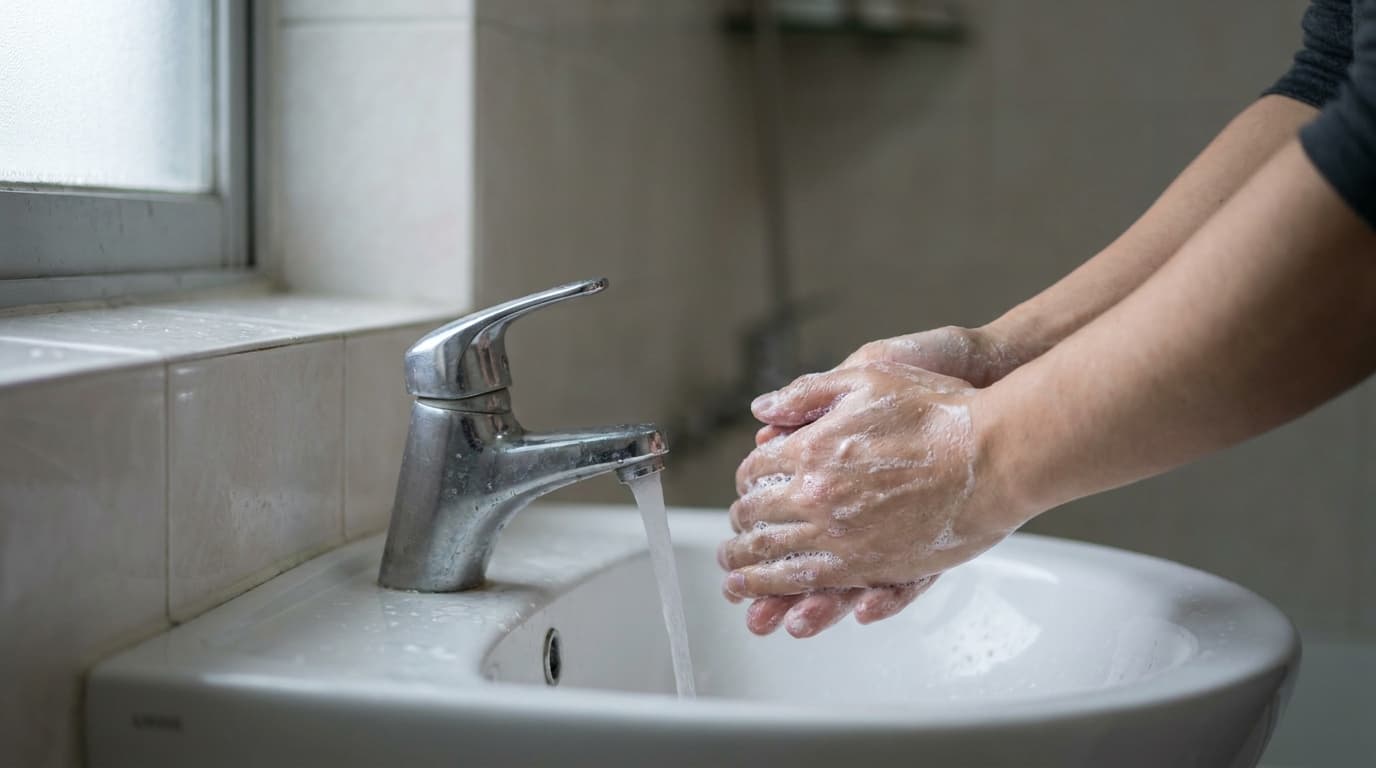
Alcohol hand gel does little to norovirus, because the virus has no fatty envelope for the alcohol to break. KDCA's wording is to wash with soap for 30 seconds "rather than hand sanitizer", fingers and backs of the hands included, and to do it every time you use the toilet, before you cook and before you eat.
For surfaces, KDCA's 2026 guidance is household bleach (4 percent sodium hypochlorite) diluted 1 part to 39 parts water, wiped on with a cloth or paper towel while wearing a KF94 mask and gloves; KDCA's January 2025 notice said 1 to 50; the 2026 figure is the current one. Bedding and clothes go in at 70 degrees, or soak for five minutes in bleach diluted 1 to 266. Clean up vomit the same way, mask and gloves on, and bag the paper. Keep the sick person on their own toilet if the flat has two, and get the whole household to wash with soap for the two days after they recover. Wash up in hot water rather than leaving dishes in the sink.
Most of us get it once, sleep for a day or two, and are fine. Knowing the rules in advance means you do not end up with a 220,000 KRW emergency room bill for something a clinic handles for a few tens of thousands of won, and you leave the first visit with the right piece of paper for work or school.
Living in a share house or a dorm this winter? Homes in Korea lists furnished rooms and monthly rentals for foreigners in Seoul, including private studios with your own kitchen and bathroom.