Korean Electricity Bills in Summer 2026: AC Costs, the Progressive Tariff & How to Avoid Bill Shock
Aug 3, 2026
It's 11 p.m. and the heat index outside is still 34°C. You've had the AC running since you got home, and honestly, so has everyone else in your building. Then the August bill lands — and the number on it looks like a typo.
Here's the bottom line:Korea uses a three-tiernuljinje(누진제, progressive electricity tariff) where the price per kWh jumps sharply once you cross usage thresholds. In summer, a typical foreigner in a Seoul one-bedroom officetel running the AC eight hours a day can expect a bill between ₩90,000–₩160,000 (roughly $65–$115 USD). Heavy use — twelve-plus hours a day at low temperatures — can push that to ₩220,000–₩350,000 ($158–$252 USD). The good news: KEPCO (Korea Electric Power Corporation, the national utility) relaxes those thresholds in July and August, and a few simple habits can realistically cut your bill by 30–50%.
How Korea's Progressive Electricity Tariff Actually Works
The Three-Tier Structure
Korea's residential electricity bill isn't just usage × price. Your monthly bill is made up of a base charge (a fixed fee that changes by tier) plus an energy charge (usage-based). The painful part is that both jump when you cross a tier.
Because this is a summer guide, here are the July–August 2026 brackets for residential low-voltage (주택용 저압) — the ones that actually apply while your AC is running:
- Tier 1 — up to 300 kWh: ₩120.0 per kWh, base charge ₩910/month
- Tier 2 — 301–450 kWh: ₩214.6 per kWh, base charge ₩1,600/month
- Tier 3 — over 450 kWh: ₩307.3 per kWh, base charge ₩7,300/month
On top of the energy charge, every kWh also carries a climate-environment fee (₩9/kWh) and a fuel-cost adjustment (₩5/kWh) across all tiers — small per unit, but they add up over a heavy month.
That base charge leap from ₩1,600 to ₩7,300 alone is a gut punch — and it hits the moment you cross into Tier 3, before you even count the jump from ₩214.6 to ₩307.3 on every additional unit.
💡 TIP: A typical 60,000 KRW (≈$43 USD) spring bill can realistically become 200,000 KRW (≈$144 USD) or more in summer — not because you're careless, but because the math is designed to escalate fast once you cross thresholds.
The Summer Relief Band (July–August Only)
Those summer brackets are already a concession. For the rest of the year (January–June, September–December), the tiers are tighter: Tier 1 ends at just 200 kWh and Tier 3 starts at 400 kWh. For July and August, KEPCO pushes those lines out to 300 kWh and 450 kWh respectively — giving you extra breathing room precisely when the AC is working hardest.
The practical takeaway: 450 kWh is your danger line. Cross it and every additional unit costs ₩307.3 plus that ₩7,300 base charge. Most expats don't see their first shocking bill until early August — three weeks after the real heat started — because by then the meter has already burned through the cheap tier and is grinding away in the punitive band.
The Real Cost of Running Your AC
Inverter vs. Fixed-Speed: Opposite Rules Apply
This is where most foreigners get the wrong advice — and pay for it.
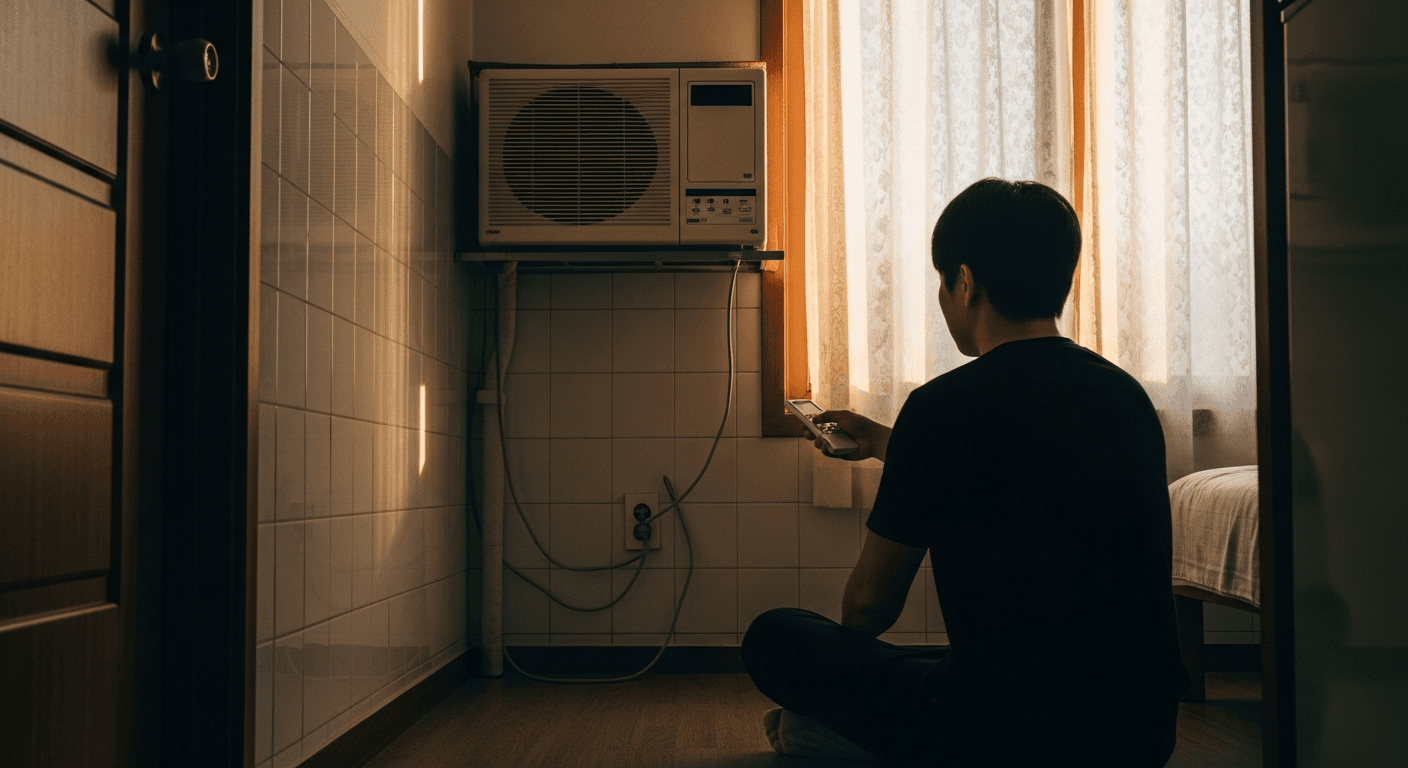
About 90–95% of an AC unit's power goes to the outdoor compressor. How that compressor runs depends entirely on which type of unit you have:
Inverter AC(most units installed post-2011, typically efficiency Grade 1–3):
- Throttles down to a low-power "cruise" mode once it reaches your set temperature
- 💡 Leave it on. Maintain a steady temperature. For trips under 1–2 hours, keep it running — turning it off and restarting makes the compressor surge from zero every time
Fixed-speed (constant) AC(older units, typically pre-2011):
- The compressor runs at full power or not at all — no in-between
- 💡 Cycle it on and off deliberately. Running it non-stop wastes power because it never throttles down
Not sure which type you have? Check your unit's energy efficiency label or ask your landlord. If it has a Grade 1 or 2 sticker, it's almost certainly an inverter.
Temperature Settings and the 7% Rule
Each 1°C lower than your set temperature adds roughly 7% to power consumption — and because of the progressive tariff, that extra usage can hit your bill disproportionately hard if it tips you across the 450 kWh line into Tier 3.
- 26°C is the recommended setting for efficient summer cooling in Korea
- Running at 22°C instead of 26°C can be the difference between a ₩120,000 and a ₩220,000 bill
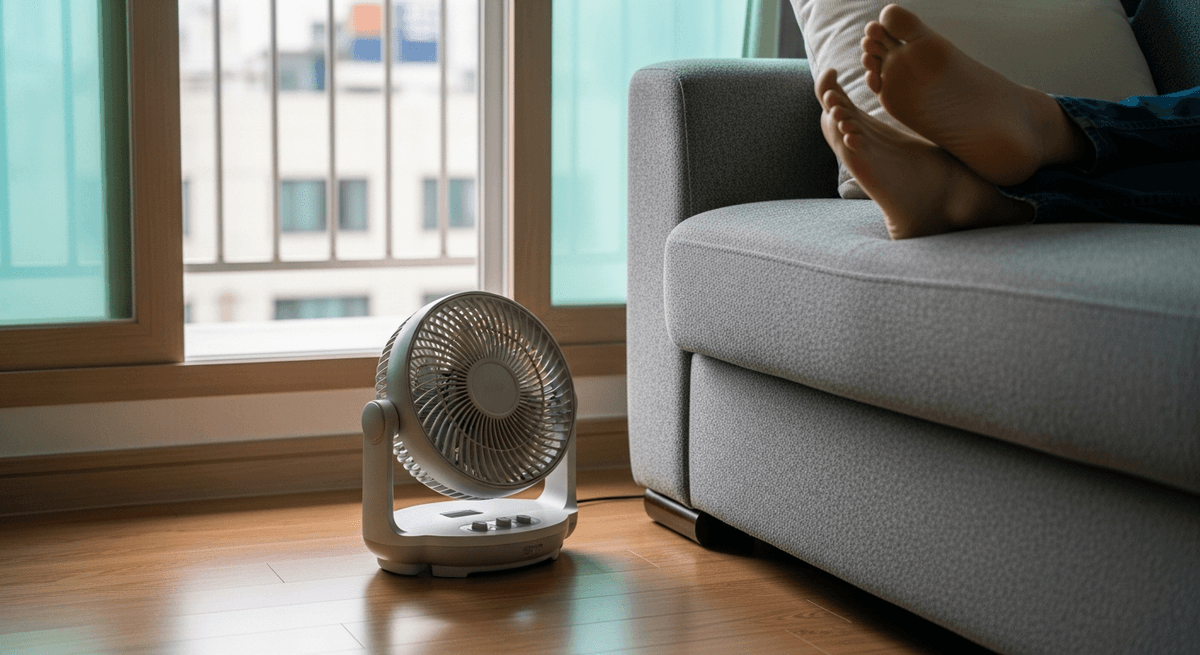
💡 TIP: An inverter AC running steadily at 26°C paired with a standing fan circulating the air will cool the room more efficiently — and more cheaply — than a unit set to 22°C struggling to blast cold air into dead corners.
5 Rules to Keep Your Summer Bill Under Control
① Know your type. Confirm inverter vs. fixed-speed before choosing your strategy. Wrong habits for the wrong machine cost money.
② Set it to 26°C, not lower. Every degree counts double under the progressive tariff.
③ Watch the 450 kWh threshold. Check your running usage mid-month using KEPCO Cyber Branch (한전 사이버지점), KEPCO's online account portal where you can monitor real-time consumption.
④ Use the fan-AC combo. An inverter AC plus a circulating fan cuts consumption by 30–40% compared to cycling an older non-inverter unit on and off repeatedly.
⑤ Pre-cool, then hold. Cool the room down while the outdoor temperature is lower (early morning or late evening), then maintain — don't start from scratch during the hottest part of the day.
Programs and Discounts You Might Be Missing
KEPCO Energy Cashback
KEPCO runs an energy cashback program that pays you back up to ₩120 per kWh for reducing your usage compared to the same period last year. The eligibility requirements were relaxed in 2026, making it easier to qualify. You can apply through KEPCO Cyber Branch — worth checking if you've been in the same apartment for more than a year.
Newborn Household Discount
If you've had a baby recently, Korean households with newborns qualify for an electricity discount of up to ₩16,000/month (≈$11.50 USD). This is something many foreign families simply don't know exists. Check KEPCO's official site or ask at your local dong (동, neighborhood administrative) office about eligibility.
High-Efficiency Appliance Rebate
KEPCO maintains a rebate program for households upgrading to high-efficiency appliances. If your landlord's AC is an old fixed-speed dinosaur and they're willing to upgrade, a Grade 1 inverter unit can cut cooling electricity use dramatically — and the rebate program helps offset the upfront cost.
💡 TIP: Start preparing before June, not after the first scary bill arrives. By the time you open an August statement, you've already run through the cheap tier. The savings happen in how you run the AC in early July.
A Note on Naengbangbyeong — And Why It Costs You Twice
Naengbangbyeong(냉방병, literally "air conditioning sickness") is a real and common phenomenon in Korean summer — the headaches, sore throats, and fatigue you get from spending too many hours in aggressively cold, recycled air. The irony is that people who keep their AC at 18–22°C to "really cool down" end up feeling worse, using more power, and often running the unit longer to compensate for the discomfort of dry air.
Keeping the temperature at 26°C, running the unit with a fan, and taking occasional breaks in the natural (if steamy) air outside isn't just good for your health — it's good for your bill.
And come winter, the same progressive logic flips to your heating bill — our guide to heating in Korea covers how to stay warm without the January version of this shock.
Korea's summer electricity system isn't designed to catch you out — but it will if you don't know the rules. The three-tier tariff was built for an era before every apartment had an inverter AC, and KEPCO's July–August relief band is a genuine concession that gives you real room to work with. Learn where your threshold sits, run your unit the right way for its type, and check your consumption mid-month. Do that, and a Korean summer stops being something you sweat through in the dark — and starts being something you actually manage.
Found this useful?BookmarkHomes in Koreafor more practical guides on living, renting, and navigating everyday life in South Korea as a foreigner. Have a summer bill story of your own? Drop it in the comments — the more specific, the better.